Showing posts with label installation. Show all posts

Saturday, February 18, 2012

Exploded Views

A group show with my work in it, including this site-specific installation "Ligeia", is currently up at the John Slade Ely House in New Haven.

This work is, for whatever reason, quite difficult to capture on film- the light coming from the windows,which in real life is glorious, makes the interior look dark and dingy in photos...
However- here is what I came up with. The work is made of buffalo and sheep wool roving,
and is titled after a story by Edgar Allen Poe, which I have been obsessing about for years.

Ely House is really beautiful without any art in it-full of window seats, diamond paned glass and lovely old woodwork, it's rooms feel rich and full even devoid of furniture.


Here is another, as-of-yet untitled work- marker and pencil on commercially produced tags with copper nails, made during the final days of 2011.

This exhibition was gracefully curated by Paul Clabby, and features the work of several other artists who I am really proud to be showing with -unfortunately, I have no pictures of their work.
All the more reason to catch this show in person before it ends!

Show information:

Exploded Views

works by Aimée Burg, Geoffrey Detrani,
Martha W. Lewis & Mark Wilson

January 15- February 26, 2012
The John Slade Ely House
51 Trumbull St.,
New Haven, CT 06510

www.elyhouse.org

Wednesday, October 20, 2010

Mind Sets and Attract/Repel: two shows that open soon


I am in TWO shows The open on the same day!
Happily, only one has it's opening reception then.
Attract/Repel is part of Central Booking's continuing series of science-based exhibitions, this one focusing on physics. It should be a fascinating show and I am really pleased to be a part of it. Central Booking is a really special gallery with excellent and eccentric programming....

Secondly, we have Mind Sets, being held at real-life hotbed of science, the Haskins Language Lab! This was really a unique opportunity, and was so much fun. Meant to be a collaboration between artists and scientists, I can hardly lay claim to any such rigor:
my work is full of fiction, rumor, superstition and innuendo.
I am very happy with it.
From the press release:
"Curated by Cat Balco and Debbie Hesse with Curatorial Assistant Steven Olsen, Mind Sets explores the potential of collaboration between artists and scientists. New initiatives and ideas result from conversations between artists and scientists, offering new ways of approaching concepts through interdisciplinary communication.
"

Featured artists include Fritz Horstman, Zachary Keeting, Lucy Kim, Eva Lee, Martha Lewis, Laura Marsh, Kim Mikenis, Carol Padberg, Dushko Petrovich, Cuyler Remick, Matt Sargent, Bill Solomon, Susan Classen-Sullivan and Paul Theriault.


Students of Natacha Poggio, a multidisciplinary designer on faculty at Hartford Art School and Director of the Design Global Change initiative, have collaboratively produced a catalogue and graphic images for the exhibit.

Haskins Laboratories is an independent, international, multidisciplinary community of researchers conducting basic research on spoken and written language. Exchanging ideas, fostering collaborations, and forging partnerships across the sciences, it produces groundbreaking research that enhances our understanding of -- and reveals ways to improve or remediate -- speech perception and production, reading and reading disabilities, and human communication."

This is an unusual setting for an exhibition and the work I've seen so is daring and varied-

worth a detour and a snoop, I'd say...


Saturday, November 14, 2009

What to see in New Haven:Time Is Like The East River

Photo: Time is Like The East River, courtesy of the artist


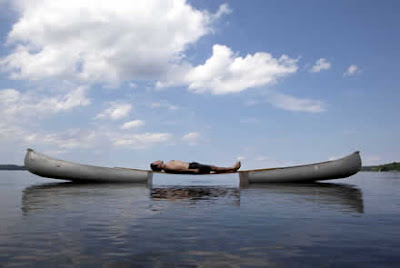
Time is like the East River, a series of elegant installations by William Lamson opened Thursday night at Artspace, New Haven. The show, curated by Liza Statton, features objects and documentation of performance work in the form of photographs and video. Brooklyn-based Lamson will be familiar to Artspace aficionados through his Long Shot installation which has been up in The Lot since September (and runs through to January 2010), here seen documented in the front room of the exhibition space.


The show is an ambitious one, in that it sets out to put several discrete works, minimal and performative in nature, into a gallery setting, and to have them coalesce e
nough to create a sense of unity to the exhibition. This is all the more challenging as Artspace’s galleries feature rooms and spaces which are quite separate from one-another. The task of providing enough cohesion without being over-literal is a delicate one.


Upon entering this exhibit, it is a bit of a cipher. The works seem vastly different- aesthetically aligned but not evidently related. You really have to look, and put it together yourself, which is a complement. I really dislike work that declares itself wholly as one big idea, leaving no room for nuance, layers of meaning, space for the viewer. Lamson includes us by not doing all the work for us: though if one needs clues, Statton's concise paragraphs which make up the wall labels offer kernels of insight for the lost. Pleasingly, the curator’s wall labels do not attempt to describe or explain the whole work, just offer some insights, perspective and a bit of background.


The name, Time is like the East River comes from a work Lamson did involving a canoe he altered by dividing it into two smaller vessels which get rejoined again after being separately paddled out from either bank in New York's East River. We are presented with this as the exhibition’s title, yet there are key works here that have no obvious connections to either canoes, or the East River. Time is what turns out to be the glue, the binder of this exhibition.
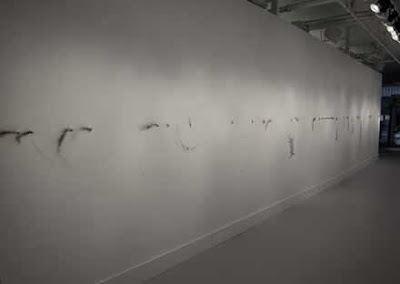


Photo: Time is Like The East River, courtesy of the artist
Around the corner, in Gallery one, is Timeline, a work which again references drawing, lines and the spanning of space. Like his East River project, Lamson starts at both ends of a distance to be spanned, in this case a vast wall. This surface is studded with holes stuffed with firecrackers, forming a horizontal line.


As with the arrows in the opposite gallery, this work creates a linear mark across a space by breaking down the flat surface of the planar wall the work rests upon. The crackers were lit, eventually meeting in the middle. What is left is a dancing ragged line of burn marks and holes. Lamson evokes drawing as a pulling of forces meeting in the middle: the line is the residue of an action or movement in space. He is ” drawing", in the sense of making a point into a line, pulling, as one does to make a small lump of metal into a wire strand.

A video in the back shows both timeline and the arrow work in process, really essential viewing for understanding both installations.

At one point I wondered if Lamson had had trouble filling the gallery’s vast spaces. My least favorite room(gallery 5) had his canoe-half displayed upright like a sculpture with a clock positioned next to it, the second hand moving backwards. The clock turns out to be set to measure slack tide, the brief period of calm on the river when Lamson and his colleague were able to cross on such small crafts. This is interesting, but in no way evident just by looking at canoe and clock, making it, for me at least, problematic. Since the canoe half and the clock are the only pieces in the room they play off of each other, and while the canoe offered a surprisingly monumental sculptural presence, with the clock the installation as a whole became a tad hokey. Maybe for an exhibition about time and it’s measurements it would seem a natural choice, but given the elliptical nature of his other work, it just seemed too blunt and obvious. I would have preferred the canoe out in the space with the other East River documents, as he did with the paddle, placing it casually leaning up against the wall. This seemed totally right: physical corroboration of the events shown in the photos and an art piece that is also a tool.


Photo: Time is Like The East River, courtesy of the artist
What is perhaps my favorite piece was tucked away in a darkened room in the very back gallery. A video, titled Drip (So are the Days of Our Lives), is shown projected onto a wall of what appears to be river silt (or cement) compacted into a vase-like shape and place on a funnel over an empty two liter bottle in a white tiled space. This video is accompanied by a soundtrack of sort of slapping or dripping noises, from a very close-up microphone. Gradually the silt starts to slide and collapse into the bottle, at first creeping slowly, then dropping in bigger and more watery blobs at a faster and faster rate. Acting as a kind of hourglass the piece again marks time and passage, going from one form and state to another through simple means. This work functions as accompaniment to the canoe journey, offering a minute, up-close version of the vast dispersion of matter across the river bed, over vast periods of time. It could be construed as a model of sorts, mimicking the epic on a very modest scale.

I really admire Lamson's use of simple materials and the graceful structures he manages to make from them. The archery frame, the halved canoe, the soda-bottle hourglass, all are cleanly put together in a spare functional way, without extra elaboration. They are matter of fact: devices with which to render time visible.

After moving myself through the exhibition, things accreted, a logic and order became visible. There is a real interconnectedness to his work which reveals itself only by slowing down to the pace of the work and really looking. For some, this will not be the easiest show to grasp, and certainly not one for someone looking for instant gratification, but neither it is not cold or off-putting. I noticed a nice phenomenon occurring during the opening: people, strangers, were looking at the art and discussing it with each other, analyzing ingredients, discussing motives. Now, to my eyes, inciting curiosity and dialogue is (to borrow from Tom Waits) a rare and a copacetic gift.


Time is like the East River

runs through December 19th at

Artspace

50 Orange St New Haven, CT 06510

GALLERY HOURS
Tuesday-Thursday • 12-6PM
Friday-Saturday • 12-8PM
Sunday-Monday • CLOSED

203.772.2709 • phone
203.772.0850 • fax
info[at]artspacenh.org

For further information visit: http://www.artspacenh.org/

Wednesday, November 19, 2008

what to see in New York: Petah Coyne- Vermillion Fog


Katrina is on my mind, and apparently Petah Coyne's as well...

Coyne is known for her baroque, globby sculptures and installations that usually have the crafty lushness of a fairy tale gone bad. Her works are always luxurious and ornate.
Here, for Vermilion Fog at Gallerie Lelong, the works consist of swathes of Velvet, plastic flowers, beads and pins, dead birds, and wax. There is a heavy gothic vibe here, a Miss Havisham's wedding cake aesthetic. This funereal splendour can usually get pretty wearying, but this time she's really hit the nail on the head. The works in Vermilion Fog suggest massive Victorian-style funeral effigies for our environmental irresponsibility.
Her installations, with their swirled lengths of purple and black velvet, evoke oil slicks, puddles of tainted water and brackish tide pools clotted with pearls, beads artificial flowers and dead birds. They rise into the air, matted together. What is really interesting about these clusters is the way they writhe and yet are so patently dead- they are glamorous, funereal stand-ins for nature. This is the concept of "nature morte" taken to it's most logical conclusion, with stuffed mallards dive bombing into velvet and flower clusters that look like hurricane thrown debris. I was stunned by these works, both horrified and touched by them.

Less successful, in my mind, are the ceiling hung chandelier-like works shown in the first room, off to the right. The ruffled cozies holding the ropes or cables bother me, they make the works look clumsy and leaden, not aloft and airborne. Also the space was crowded and all one could do was peer in, with orate works like this, it is MUCH more satisfying to be able to wander around it, sense it's breadth and mass in relation to one's own body. My complaint is really more about installation and spatial choices than the works themselves- they looked uncomfortable and a bit ware-housed in that space.

The white wax and fake flower lattice hanging from the right door jamb in particular needs a different space than the ones the gallery offers. It is also a pity that there were no shifts of natural light over the works, no interesting atmospheric lighting at all, in fact. I have no idea if the fault is hers, or the preparators, but the installation of these works is flabby and lacks drama and energy.
Coyne's latest work verges on greatness here : an anger, a helpless fury seeps through the gaudiness and lavish textures to make a veritable wake for our own selfishness and short-sightedness.She has presented an apt and timely as a statement of our collective predicament, using a truly surprising set of materials to do so.

Petah Coyne:
Vermilion Fog
oct 24-dec. 13 2008
gallerie Lelong
528 west 26th st
ny, ny 10001
t: 212 315-0470

Sunday, October 19, 2008

Errata

OOPS...

sorry folks.
I made a mistake in my posting of 9/21/08 .
The title for the project that "Pull" was created for was
"Factory Direct", not "Factory Fresh"- the posting has been changed, and so is now, hopefully blissfully free of factual errors.
Though that does seem to be a lot to ask, doesn't it?

Sunday, September 21, 2008

what to see in new york!


PULL

September 10-November 8, 2008
The other day I went to hear the artist, Jane Philbrick talk with exhibit curator curator Eric C. Shiner and MASS MoCA curator Denise Markonish. They discussed the creation and meaning of Philbrick's large-scale installation currently showing at Location One. Philbrick made the work during a residency at a security alarm system factory in Connecticut, as a part of Markonish's ambitious "Factory Direct" program.

"Factory Direct" put artists into some of the many struggling factories that used to abound in the state. There are fewer and fewer these days, but for a long while the nutmeg state was a manufacturing epicenter. The program highlighted the various ways and means of production we engage in, on a micro and macro scale. It also allowed artists and non-artists to work together, and to realize commonalities between their modes of production.

Clearly, Pull was a successful collaborative effort between the artists and the employees of the factory, to the point where they still help to install the piece in it's re occurring incarnations.

This talk was illuminating on a number of levels. First, the artist, Jane Philbrick, is articulate and a skilled public speaker. She talks with precision, deliberation and dramatic effect about her process. The piece, constructed just after 911 conjures up the hysteria and pomp associated with creating a sense of public safety, and the knowledge that this is really only a sense, only theatre. That no one is really safe anymore. Attached to this is the fear mongering and manipulation by our government, to use and exacerbate our fear to political ends. She spoke poignantly of this, and at the same time, the other two curators, both orchestrators for "Factory Direct", provided fun and interesting highlights of the process of going into the factories, making work on such a large scale, the various problems and joys of translating the artistic working process to outside of the studio and gallery milieu.

That being said, the work is now very much a gallery piece.
I would imagine that there would be enormous obstacles involved in putting a large work which signals false emergency alarms, loudly and brightly, into any sort of public sphere.
The work was shown at Artspace in new haven, then in a more rural setting in Sweden, and now in Location One.
I wish it were possible to put it outside somewhere, inviting the innocent bystander to walk in and sound the alarm- the problem with the work is that it inevitably preaches to the converted. The lefty liberal arty types who go to such exhibits are likely very much in agreement with the artist already, and the naughtiness and surprise involved with pulling the alarm box handle is strongly mitigated by it's gallery surroundings. Clearly, one is supposed to do it, one is ALLOWED to do it, even encouraged, thus removing the real edge the work might otherwise have.


This talk was by far the liveliest, most articulate one I have been to in a long time. I always appreciate hearing more about the work I see, but the three speakers were so comfortable with each other, and had clearly been through something together during the formation of this piece. That made the talk special, and very happily relaxed and unpretentious.


I admire the optimism behind initiative's like "Factory Direct"- I would love to participate in such a thing-and Phibrick's resulting work is of a really high standard. Fun-yet-serious, very visual (and aural!), it smoothly combines concept with realization. Best of all, it is not uni-dimensional in it's concept- the piece is open ended and leaves the thinking to the viewer, with a rich amount of mental fodder to chew on.

If you are in the area, by all means go visit.
There is a lot of art out there right now, but not all of it is this satisfying.


"PULL is an installation of of 430 fire alarm strobes, 312 smoke detectors, six speakers, 84 fire alarm control panels in our main gallery exploring the nature of security, fear and war. "
Free admission, open to the public.

HOURS: Tuesday-Saturday 12–6PM

Location One:
26 Greene Street
(between Grand and Canal St)
New York NY 10013 - tel. 212.334.3347
Subway: Canal Street stop on N,R,Q,W - 6 - A,C,E